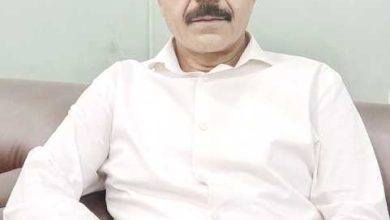
Naseem Sadiq to Azmat Firdous of Manchester, Faisalabad, Pakistan, from Faisalabad history till now, who has done what?
Columnist. Mian Nadeem Ahmed
Faisalabad is called Pakistan's Manchester because it is an industrial city, Faisalabad is the third largest city in Pakistan in terms of population. It is comprised of districts of Faisalabad, Maritime, Jaranwala, Tandalianwala and Chak Jhumra.
Hafizabad and Sheikhupura, north of the district, Nankana in the east and Sahiwal, Sahiwal Okara in the south, Jhang and Toba Tek Singh in the west are located. In the past, there was a clutter and the forests were spreading.
There were signs of rural life. Whose residents were called Jangli and are still villages that are famous for Jangli. It was called by the name of the Sandal Bar. Although the cultural and social traditions of the Sandal Bar have a long history of thousands of years in their background, the district was counted in the most backward areas of the Indian subcontinent. There are three different traditions about the cause of the sandal bar. One is that Dala Bhatti's grandfather was named Khan alias Sandal, the other was also the name of the robbers of the hills of Shahkot, and thirdly, the name of the chief of the jungle was Chahar Khan Arif Sandal. The area became famous in the name of one of the three.
1885Lieutenant Governor Mr. James Lyall, traveling from Lahore to Jhang city, staged a banquet in the Chiniot Tehsil, a Sandal Bar, in a village of Piki Madi in the Lush and Shadab area. A young English engineer, Captain Nig Shahi, was with him. James Lyall traveled the horses during a few days' stay in Piki Madi and traveled the area for several miles on all four sides of the pavement. Tasted the wells of the wells. At several miles, locals built their homes with raw houses. James Lyall planned to settle the area of the Sandal Bar due to fertility and for this purpose, the construction of a new city at the southwest from Piki Madi to the southwest. So before the construction of the city, the construction of the Canal Rakha Branch began. Villages and construction of roads began. The railway line was arranged from Sangla Hill to Shore Kot and thus the village was working on the project of allotment of agricultural areas to the people of East Punjab in different villages. First 1890 I harvested the forest and the current hour house was made well and the foundation of the city was laid 1892 After the completion of the Canal Lower Chenab, the arrangement began. 1895 I started the railway. 1899 I Toba Tag Singh and 1900 I was mixed till Khanewal. When some populations of the city had also come into existence and offices had also been made, Lieutenant Governor of Punjab Surgems B. 212 The foundation stone. Its four acres of land was named Lyallpur. Lyallpur Colonization Officer Sir Captain Poonam Young made a map of Sudan's capital Khartoum on the style of Union Jack for Lyallpur.
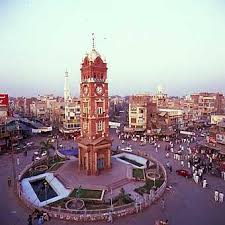
1897The Caesari gate was built in the same way. The door was built by Lala Mohan Lal Khalif Bihari Lal on the occasion of the Golden Jubilee celebrations of Queen Victoria. Gumti was constructed at a distance of about one hundred and fifty feet from the Caesar Gate. For many years after the establishment of Pakistan, it was used as a passenger box. The words "Blessed River Chani" are listed on its sides. Residential houses were in construction until 1898 at the foot of eight bazaars in Lyallpur and eight markets. An hourly house was built in the middle of these markets. Its opening 14 In November 1903, Sir Charles Raws Governor Punjab. The government had imposed a tax on the landowners for the construction of the house for an hour. It cost a total of forty thousand rupees. The hour -long home construction is a rare model of English architecture. All around it was Rail Bazaar, Jhang Bazaar, Kachari Bazaar, Chiniot Bazaar, Bhuana Bazaar, Aminpur Bazaar, Montgomery Bazaar and factory bazaar. Four of these eight markets are tight and four are tight. It is also referred to as the UK flag. The hour house was built under the supervision of Gulab Khan, a family of the family of the builders of the Taj Mahal Agra. The clock was provided by a watchman in Bombay. The city was designed by Dismand Young, but the design was originally given by Sir Ganga Ram. The first town was Douglas Pura. Lyallpur was given the status of a municipality of rank II in 1899. In 1904 it was formed a municipal committee.
Committee limits - Acter land, city population 9 Thousands and a Anglo -Warnicler School. At that time Lyallpur was in Jhang district as Tehsil. In 1902, it was given the district status of the district, Toba Tek Singh and Lyallpur tehsils, while Jaranwala was given a sub -tehsil status. Later, Jaranwala also got a tehsil status. After the establishment of Pakistan, Toba Tek Singh was made a district in 1979 and the limits of Lyallpur district decreased.
The district's two million acres of land was divided by one square farmer four to five square and six to twenty squares. Citizens land was sold for one rupee per Marla. In 1902, the foundation stone of agricultural college was laid for the promotion of agricultural education and research in the city. The college building was completed in 1909, which was named Punjab Agricultural College and Research Institute and later divided it into two parts to promote agricultural education and research in the form of the establishment of West Pakistan Agricultural University and Ayub Agricultural Research Institute. Given In 1910, the primary school was established here, which is nowadays MC Higher Secondary School Allama Iqbal Town.
1911The population of Lyallpur consisted of 5,000 people and here 11 There were ginning factories. The Caronation Library was established in the 5th century, which is the current Allama Iqbal Library. The boys' college and the Girl's College got a degree in the 5th. Now the boys' college has become a university status. After the establishment of Pakistan, as many Sikhs and Hindus were settled here, they all migrated to India and replaced Muslims from areas of Jalandhar, Hoshiarpur and Amritsar. Thus the culture and culture of the city and the region took a new color.
Prior to the establishment of Pakistan, the festival was reserved for livestock instead of Jinnah Colony. It was shifted to the current area of Iqbal Colony on the maritime road in the 1950s and moved to the present bypass in the 1970s. After the establishment of Pakistan, grain was shifted from the factory bazaar and the Rail Bazaar to Dijkot Road. At the time of the establishment of Pakistan, the population of the city had spread out of eight markets to the colonies of Tariqabad in the rear of Santpura, Pratab Nagar, Harcharanpura, Gurunanakpura, Model Town and Paki Madi.
Immediately after the establishment of Pakistan, the People's Colony and other residential areas began to be constructed on the other side of the canal. Ghulam Mohammad Abad, Samanabad, D -Type Colony, Rizabad, Afghanabad, Ayub Colony and Nazimabad residential projects were built in the 1950s and the decades. Later, colonies of Madina Town and People's Colony were constructed. The construction of Gulistan Colony, Gulfshan Colony, Millat Town, etc., spread for several miles in all four sides. Taj Colony, Mansurabad, Gulshan Colony, Sidhupura, Khalidabad, Jinnah Colony, Shadab Colony, Raja Colony, Model Town, Allama Iqbal Colony, Abdullahpur, Wapda City, Tariqabad, Islam Nagar, Gul Bihar, Gulberg, Shalimar Park, Rantinatown, etc., is its main residential settlements.
1977In Saudi Arabia, Shah Faisal was martyred, the government of Pakistan changed the name of the city from Lyallpur to Faisalabad for solidarity. In 1981 it was made the divisional headquarters and included districts of Faisalabad, Toba Tek Singh and Jhang. 2000 With the establishment of a new district system, the divisions were abolished. In 2008, the divisions were restored once again, and the Faisalabad division was re -established. Textile College and Iqbal Stadium were built in 1959. Then Millat became College and Airport.
1973Punjab Medical College was established in AD. The Chamber of Commerce and Punjab Beverage Company, the Agricultural Development Corporation Bank and the 1976 FDA and WASA were established in 1974. Pakistan Television Broadcasting began in 1980. In 1983, the city's population exceeded 100,000. Today it is the third largest city in the country. It is also known as the Agricultural University, Nayab, Ayub Agricultural Research Institute, Banji and the Forest Research Institute Gutwala, also known as Science City.
It is the country's largest city in the textile industry. Its yarn market is the largest yarn market in Asia 400 More than large industrial factories are working. Most of them are cotton cloth factories. Faisalabad is also third in the country in terms of industry and commerce. During the establishment of Pakistan, there were about two dozen small factories. Now the number of industrial units is more than a thousand. Apart from the clothes industry, flour, pitc, benasty ghee, edible oil, beverages, sugar, plywood, chip boards, artificial fertilizers, hosiery, starch, glue coas, art silk, There are many factories for textile machinery, agricultural equipment and clock manufacturing.
The soaping industry is also on the rise. Faisalabad also has the privilege of hosting Quaid -e -Azam Muhammad Ali Jinnah. Quaid -e -Azam visited here during the Pakistan Movement in 1943 and addressed a gathering of thousands of Muslims in the field of Dhobi Ghat.
Faisalabad is a century -old city and its cultural roots are not deep and old. Dr. Saeed Akhtar Durrani, a scientist in the field of science, was born in Faisalabad. The star was awarded the distinction in return for scientific services. Another scientist here is Dr. MA Great. The late Nusrat Fateh Ali Khan gained a unique position in Qawwali and specific singing and gained international fame.
Politicians, bureaucracy, civil society, businessmen, industrialists have a huge role in the development of Faisalabad. Various political parties of Pakistan also started many of their movements in Faisalabad. In Faisalabad, several commissioners, deputy commissioners were appointed. Everyone played a role in enhancing its beauty in their own style. DC Naseem Sadiq, who was posted in Faisalabad, spent a long time in Faisalabad. He had taken home in people's hearts on the basis of his work and performance. The child of Faisalabad was familiar with the name of Naseem Sadiq. They cleared Faisalabad from professional beggars. The elimination of transport bases from Abdullahpur, cleaning under the Jhala bridge, eliminating workshops near the station, eliminating encroachments from Jhumra Chowk and other plans were included. He was famous for knowing to work with people and knew to work with people and even knew how to establish a government writ. He was visiting the streets early in the morning, visiting the markets. They left their pictures wherever they went. Subsequently, it is said that another Naseem Sadiq has arrived in Faisalabad. Now that Chief Minister Punjab Maryam Nawaz has decided to clear the entire Punjab from the encroachments, Faisalabad, which is the center of business, comes from other cities to buy traders. And is the most revenue city. It was also a matter of passing through its markets. The shopkeepers had rented the road in front of their shop, leaving the spine, sticks or crackers. And thousands of rupees used to collect monthly rent. And it was heard that the corporation staff also received their entire share. Dakandra did not allow anyone to park a motorcycle, a car in front of his shop.
The target commissioner, deputy commissioner and Mosanpel Corporation were also handed over to other areas of the city along with eight markets. Commissioner Salvat Saeed also tried to perform well but perhaps the ticket holders of Faisalabad did not meet the standards. And she left from Faisalabad.

Azmat Firdous Deputy CEO Municipal Corporation is being called the second Nassim Sadiq of Faisalabad. Who is a domineering, courageous and hardworking officer. I met him in various NGO programs, reflecting the truth and the spirit of working in his speeches. I gave them my Radio Pakistan FM 93 When invited to contact the current program -based program, he filled the supporters. And participated in the live program. Even during the program, she was talking with a lot of confusion, confidence and a spirit of patriotism and was answering my questions as well as answering live questions. Even during the informal conversation after the program, what I saw most of them was a factor of courage and honesty. She told her that she belonged to a village in the Chiniot area.
Now that the target of elimination of the encroachments has also been entrusted to them, they are working with the same courage that they were seen in them. Don't work. She is visiting the house in the house and in other markets and is also monitoring the operation. Although traders and shopkeepers do not like them and their performance is being criticized. The heads of the association traders are also holding meetings with them to resolve the issue in some way. But they say they can transfer them, but do not back down.
If Faisalabad wants to see his city even more beautiful, then Naseem Sadiq To has to allow his greatness to work, his work will not be criticized. Instead of confusing matters, you have to take the solution. Traders should also understand the fraud of the matter and support the administration in eliminating the encroachments and foster their business.
At the same time, civil society will have to stand with greatness. Otherwise the city is now open. All the markets are free from encroachments. If you stand home for an hour, you will see the district council building. They will be done again, and then the corporation staff will start receiving the arrangements. Similarly, there will be no place to pass. And the clean city will become a dream.